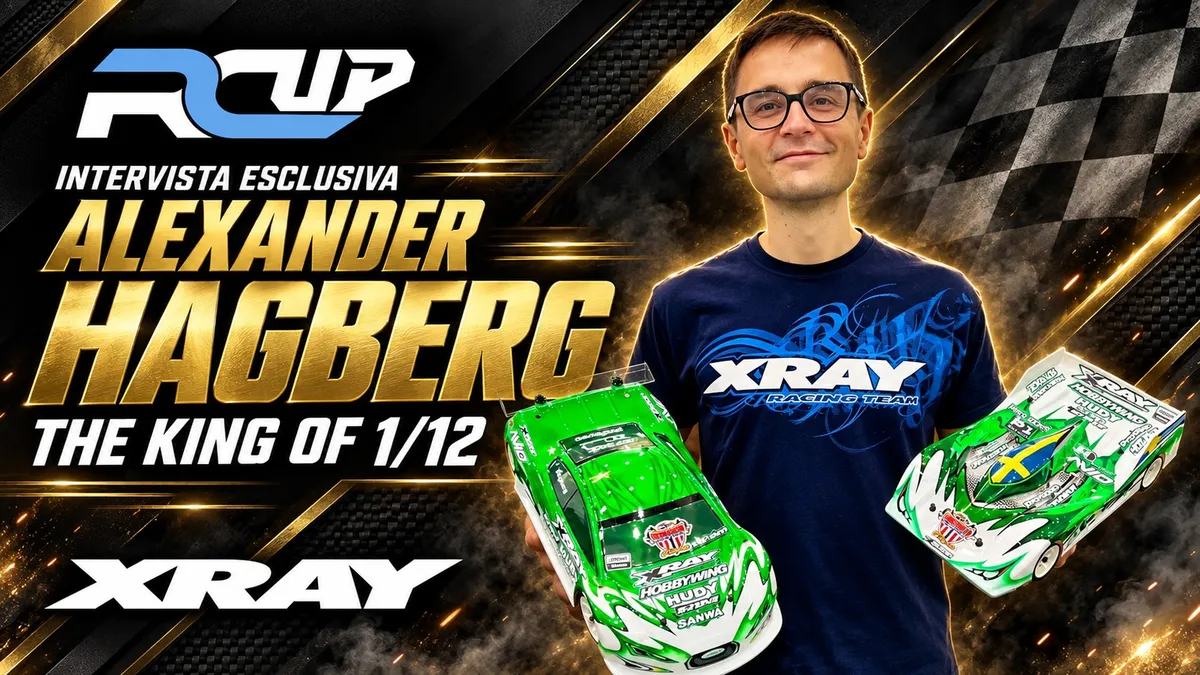
The King of 1/12
There are drivers linked to a brand. Then there are drivers who, over the years, become part of that brand’s identity.
Alexander Hagberg belongs to that second category.
More than twenty years with XRAY and HUDY. Nitro Touring World Champion, 1/12 World Champion, 2026 European Champion in 1/12 Modified. And now a project with his own name on it: AH Signature.
We talked about loyalty, development, 1/12 and Touring, telemetry, specialisation — and the losses that stay with you longer than the wins.
What came out is an interview about what it means to stay at the top when everything around you keeps accelerating.
Alexander, you've been with XRAY for practically your entire international career. In a sport where we've seen champions change brands even at the peak of their success, you've almost become part of XRAY's identity yourself. After more than twenty years together, is your relationship with the Hudy family still that of a driver and a manufacturer, or do you now feel like you're part of the project on a much deeper level? And was there ever a moment when you seriously thought your paths might separate?
I've been trying to build a career with XRAY, both on and off the track, for a long time. They were my first sponsor and have supported me since the early days of my racing career. My heart and soul are with this company, and my goal is to maintain this relationship for a very long time, even after my professional racing career comes to an end.
But just as my international racing results and brand name would not have been possible to achieve without their support, it goes both ways. I've also helped them build their brand and product popularity through my hard work and international presence throughout the years.
I've discussed deals and contracts with other brands, but to be honest, there was never any serious consideration on my part to leave the XRAY and HUDY brands!
You're probably one of the very few drivers in the world who can talk about both 1/12 and 1/10 Touring at the absolute highest level with the same depth of experience. Yet the feeling between the two seems completely different: in 1/12 you remain an absolute benchmark, while Touring has become an incredibly tight battle at the top. When you pick up an X12 and when you drive an X4, what actually changes in your mindset and driving style? Is there something you can still do almost instinctively with a 1/12 car that you have to work harder to achieve in Touring?
I've been fortunate to race both categories competitively for many years. The driving styles are quite radically different, but you can use characteristics from both categories to improve in the other.
For example, the precision and aggressiveness needed for 1/12 can be applied to TC driving as well. Likewise, the smoothness of throttle and brake management from TC racing can be used to your advantage in the 1/12 category.
Personally, my aggressive, point-and-shoot driving style is actually perfectly suited to 1/12, or to TC on high-grip surfaces. Where I need to improve is driving TC on lower-grip surfaces and on tracks with more flowing, open corners, where a smoother approach and wider driving lines are needed.
I am always trying to be a good self-critic so that I can evolve and improve my driving and race preparation.
In 2026 you once again became European Champion in 1/12 Modified. After so many years of developing the X12, finding extra tenths is no longer about completely reinventing the car but about increasingly small details. As a driver, how do you distinguish between a genuine technical improvement and something that simply feels better? And what is currently the hardest limit to overcome in the development of a modern 1/12 car?
1/12 is about precision, not only in driving but also in paying attention to very small details. I've always had a good feel for preparing a car perfectly and paying extra attention to the small details. This is very rewarding in a class such as 1/12.
Furthermore, tire preparation is an area where 1/12 differs from TC, since tire choice and preparation are less controlled, allowing you to use your accumulated knowledge to your best advantage. I really enjoy this class for these reasons.
Driving-style-wise, I have enough experience to know what's needed to go fast in the class. The most challenging part has always been, and still is, finding the correct setup and tire preparation quickly enough for any given track.
Most enthusiasts see you as an XRAY factory driver, but behind the scenes you're also deeply involved in testing, development, gathering feedback and working directly with customers. When your feedback reaches Martin Hudy, how much influence does it actually have on the development process? Have you ever strongly pushed for a technical solution that others initially didn't believe in, only to later discover that you were right?
I am deeply involved in product development for the X4 and X12 platforms. I enjoy being part of the process, since I particularly like working on the cars and trying to make them go faster.
I am not a designer or engineer, but I have a good idea of what is needed to improve a car or how to make it faster. Some of my ideas and suggestions have been directly implemented into the current platforms. I take pride in that.
Of course, there have also been ideas that were rejected, but occasionally, I've been able to convince our designer to use my ideas after successful on-track tests and some persuasion. Those moments are very satisfying.
Recently you've done something different by putting your own name on a project outside the race car itself: AH Signature, created together with Antonino Mangiaracina, starting with a T-shirt line and potentially opening the door to a wider range of RC-related products. Is this simply Alexander Hagberg merchandise, or is it the first step towards building a genuine independent brand? Looking further ahead, could we eventually see a technical product designed directly by you carrying the AH name?
The idea behind the brand for now is simply to promote it and gain some recognition. The long-term plan is to eventually offer products for competition racing, using my years of experience and know-how to develop useful products for fellow racers.
My time is quite limited, so don't expect a big product portfolio just yet. It will be a slow but, hopefully, exciting process!
There's an interesting aspect to your career: you've spent most of your life inside one of the most technically structured organisations in RC racing, while at the same time developing a very distinct identity of your own. After so many years within XRAY and HUDY, how difficult is it to understand where the company's technical philosophy ends and Alexander Hagberg's own philosophy begins? If someone gave you a completely blank sheet of paper tomorrow and said, “Design your ideal race car with absolutely no restrictions,” how different would it be from an XRAY?
Like I mentioned earlier, I have no formal education in engineering or technical drawing. I do have a good idea of what a car should look like and how it should handle, but if I were to design my own car without the help of XRAY, it would be a very tough task!
I've always seen myself as a part OF the process rather than THE process behind these car platforms. I would not be where I am without XRAY, nor would their products be as good or as popular if I hadn't been with them – this is the truth!
This is why I plan to stay with them for a long time, hopefully continuing this fruitful relationship for both parties!
Touring Modified seems to have reached a point where the level of both the top drivers and the cars is so incredibly high that just a few hundredths can completely change a race weekend. Are we reaching a stage where performance depends more on understanding tyres, track evolution and changing conditions than on the actual design of the car? In other words, in 2026, how much difference can a completely new chassis still realistically make?
It's true that modified touring car racing is more extreme and more difficult than ever. It's extreme because of the high speeds, mainly due to modern electronics technology, but also because of the high-grip natural rubber tires and high-downforce, lightweight bodyshells.
For this reason, car design, setup, and configuration have become more delicate than ever as well. It's obvious that many modern TC cars on the market look very similar in terms of geometry, flex, and weight distribution.
Of course, if you're able to design a concept that somehow has a significant performance advantage over current car platforms, that's always the goal. But ultimately, it's very difficult to achieve without an immense budget, unlimited time, and a big team behind you.
You've raced against several generations of champions and you've seen the way drivers prepare for races change completely. Today we have telemetry, huge amounts of shared setup information, videos, data and very young drivers arriving with an impressive level of technical preparation. But do you think this new generation is also losing something? Is there a skill that drivers who grew up having to “feel” the car developed naturally, but which could slowly disappear in modern RC racing?
I honestly think that a lot of the data, telemetry, and similar “paddock” approaches that are becoming increasingly popular often confuse us more than they help us.
After all, we're racing RC cars, and we're not multi-million-dollar F1 teams with several engineers per driver. The vast majority of drivers are their own mechanics and race engineers. And to do that, you need to simplify things a bit, in my opinion.
The younger generation of racers, to generalize a bit, doesn't seem as technically experienced as drivers used to be. On the other hand, they grew up with digital entertainment, such as video and PC games, which has brought their hand-eye coordination to very high levels – something that is fundamental to success as an RC driver.
You've been a World Champion in both Nitro Touring and 1/12, reaching a level that very few drivers in RC history have achieved across such different categories. Today, however, you're racing against drivers who may build almost their entire preparation around one specific class. Do you still believe being such a complete and versatile driver is an advantage, or has extreme specialisation become almost necessary if you want to be the very best in the world?
You almost answered your own question there at the end. The short answer is that, no matter how talented or versatile you are as a driver today, it has become almost impossible to excel in more than one class.
You are almost forced to focus all your time and effort on just one class if you want to give it 100% and win a World Championship. Every class has become so specialized that it's absolutely crucial to dedicate all your time to it if you want to become the best.
I don't want to finish by asking you which victory means the most to you, because you've probably been asked that hundreds of times. So let's turn the question around: which race that you didn't win would you immediately choose to go back and race again if you had the chance? And more importantly, what would today's Alexander Hagberg do differently from the driver you were back then?
Without a doubt, my hardest loss was at the 2009 EFRA European Championships on carpet, which were held in the shopping mall at Lingotto in Turin, Italy.
In the touring car class, I qualified 2nd and had a chance to win the title, only to throw it away with a costly mistake in A3. It was my first chance to become a European Champion, and it hurt a lot to miss out.
My second-hardest loss was the 2018 TITC, which I famously lost to Akio Sobue in a dash to the finish line at the final corner. Akio had hit my car two corners from the end, which tucked my bodyshell and eventually made it difficult for me to defend my line in the final corner. People often overlook that. It was a defeat that was difficult to overcome as well.
RCup.it — Takeaways
Talking to Alexander Hagberg means listening to someone who doesn’t need to invent a character: time has already built one.
More than twenty years with XRAY. A bond with HUDY that he himself describes as heart and soul. A 2026 European title in 1/12 Modified, won in an era when tenths no longer come from revolution but from obsessive precision. And, at the same time, the clarity to admit that today — no matter how complete you are — winning a World Championship almost forces you to specialise.
It only looks like a contradiction. Hagberg remains one of the few who can still think like a complete driver, yet he reads modern paddock reality without filters: the sport rewards those who put all their fire into one class. That isn’t nostalgia. It’s level.
His view on development is just as telling. He doesn’t cast himself as the engineer behind the car, but as part of the process. Ideas accepted, ideas rejected, on-track proof, persuasion. It’s the balance between factory driver and product man: less marketing, more dirty work on the bench and at the track.
Then comes AH Signature. Not a full catalogue yet, not a finished technical brand: a beginning. But the direction is clear — take a piece of personal experience beyond the XRAY suit, slowly and without forcing it.
And at the end he chooses Turin 2009 and TITC 2018. Not the wins. The wounds. Because if you ask a champion what he would race again, he rarely picks a triumph. He picks the day something slipped away.
Less confusing telemetry. More feel. Less character. More process.
That, today, is Alexander Hagberg’s lesson.
RCup.it — Full Throttle RC Community.