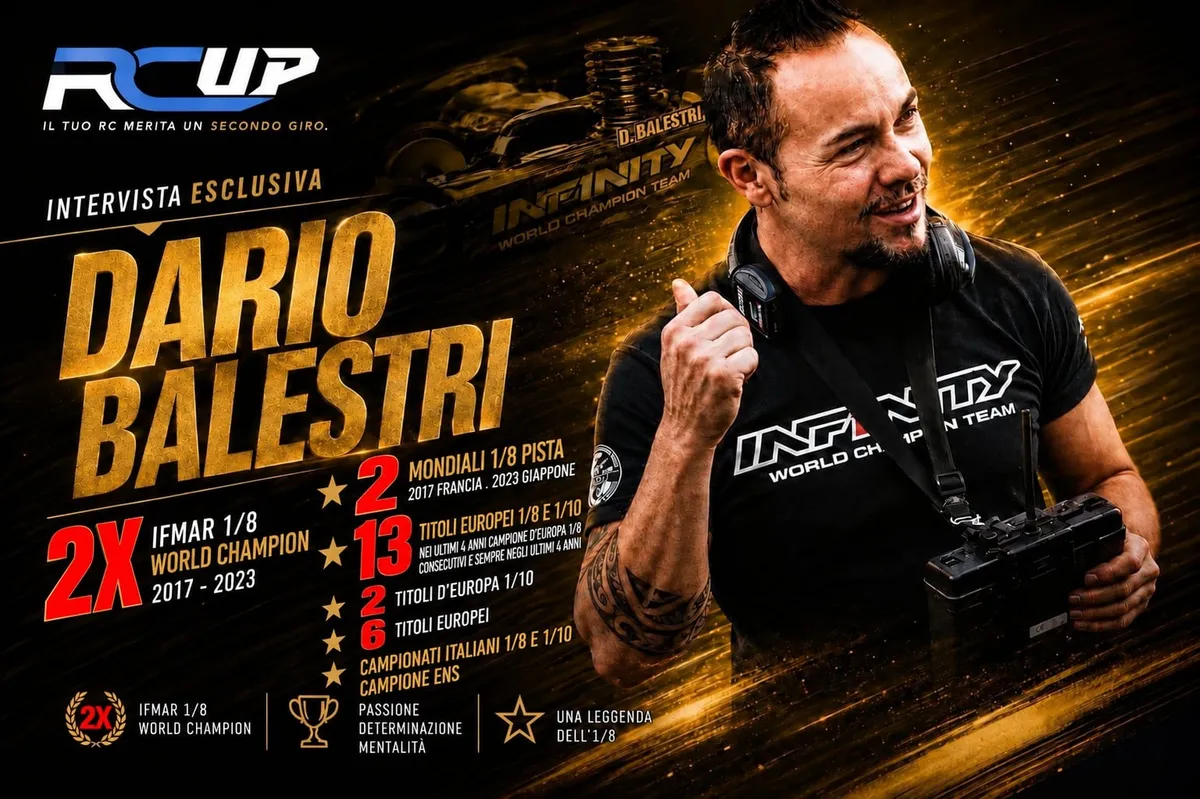
Two-time IFMAR 1/8 On-road World Champion · Infinity World Champion Team
Some drivers win a race. Others, season after season, become the benchmark against which everyone measures their level.
Dario Balestri is the man to beat.
Two IFMAR 1/8 on-road World titles and a career built on speed—and, above all, consistency. We discussed the pressure of starting as the favorite, the unseen work before a race, Infinity development, transmitter details and trust within the team.
Without avoiding the most difficult question: what really happened at the 1/10 World Championship in Gubbio.
Experience, hunger and pressure
Dario, looking back at your career and the long periods in which you collected victories, what step enabled you to become so consistent? Winning changes how you approach races: how do you stay hungry and manage expectations when everyone sees you as the man to beat?
«I believe consistency came mainly with experience. When you are young, you think a lot about the result; over the years, you learn to give more importance to the entire process that leads to it. I learned to prepare for races better, to understand the car and, above all, to know myself better.
Being considered the man to beat certainly adds pressure, but I try not to experience it that way. In the end, when you are on the track, you have to focus on doing your job as well as possible. My hunger does not come so much from having to prove something to others as from my personal desire to improve and see how far I can go. Every race is a new challenge, and the outcome is never written in advance.»
Race preparation and adaptability
How do you prepare for an important race, from work at the bench to track testing? Which aspects must already be settled before leaving, and how much room do you leave for decisions at the circuit?
«Preparation begins long before arriving at the track, with many hours of sacrifice at home, sometimes even at night.
We try to arrive at a race with a car we know and a clear baseline. Reliability, the correct operation of every component and a balanced setup are aspects that must already be in place.
Once at the track, though, you cannot expect everything to be settled in advance. Conditions change, grip changes, temperature changes, and the car’s behavior also changes during the day. That is why it is important to have a good baseline while being ready to change things when needed. In my opinion, adaptability is a fundamental part—perhaps the most important part—of an experienced driver’s work.»
For a driver with your experience, how important is training still, and how do you make a day at the track productive? Do you focus mainly on the fastest lap, consistency in long runs, or adapting to a car whose behavior changes during the race?
«Training remains essential. In fact, perhaps experience makes it even more important because you know exactly what you need to look for during a day at the track.
I do not focus only on the fastest lap. Speed is important, of course, but in a long race the difference is often made by consistency, tire management and the ability to maintain a high pace without making mistakes. I therefore work extensively on long runs and on driving the car even when its behavior changes. A car that is perfect for two laps is not very useful if after twenty minutes you can no longer drive it.»
Infinity: sharing knowledge to grow
In the videos you make for Infinity, you share your experience with customers by explaining practical solutions and details. How important is this knowledge sharing in helping buyers truly understand their car, and what is the most common mistake you would like racers to avoid?
«For me, it is a very important part of my relationship with Infinity. A car must not only be fast in the hands of a factory driver; it must also be understandable and usable by someone who runs it every Sunday.
In the videos, I try to pass on those small pieces of information that may seem trivial but can greatly change the car’s behavior. The mistake I see most often is immediately chasing extreme performance by changing many things at the same time. I believe you should start with a balanced car, make one change at a time and always understand why you are making it. Only then can you truly learn your car and adapt it to your driving style—with humility.»
The details that make the difference
Among the details worth considering is even the position of your fingers on the transmitter, so you can reach certain functions during a race without losing precision. How do you arrange your grip and controls? Can you share a practical tip an enthusiast could try?
«The key is to have a grip that allows you to be precise while reaching the controls you need without changing your hand position as you drive.
I always try to keep my hands in a very natural position because, in a race, you should not have to think about where your fingers are; everything must be automatic. One tip I recommend is to practice using the secondary controls without looking at the transmitter, either at home or during a relaxed session. If you have to move your whole hand or lose your position on the radio, there is probably something to improve in your setup. They are small details, but under pressure they can make the difference.»
Complete trust in the team
How important is it to have people such as Massimo Fantini and Mannucci alongside you in technical work and in the pits? What does each contribute, and how much does trusting those who manage the car and make crucial decisions with you affect your driving?
«It means everything. In a race at this level, the driver is one part of the result, and having people you trust completely allows you to focus more on driving. Having Massimo Fantini alongside me gives me complete confidence in the engine and carburation department, and I believe this is one of the keys to my results. Likewise, Mannucci has always done an impeccable job on refueling over the years.
When you are racing, you need to know that the people beside you are working in the same direction, with the same desire and motivation to win. That trust lets you stay focused on driving and avoid doubts when decisions must be made quickly. If that trust is missing, some fundamental aspects of the team definitely need to be reconsidered.»
The difficult question: the Gubbio Worlds
A difficult question: at the 1/10 World Championship in Gubbio, what did not work in your race? With hindsight, where do you feel you could have done better, and is there a decision you would change today?
«There was certainly one episode in Gubbio that weighed heavily on my race: during a tire change, we lost a lap and a half because a wheel could not be fitted. In a race at this level, unfortunately, such an error carries an enormous price—the loss of the race.
I was especially disappointed because we had worked so hard to reach the World Championship in the best possible condition, and losing a lap in that way completely compromised the race.
With hindsight, I would not change any particular technical choices made before the race because everything was working at its best. Instead, that is an episode we must work on, because at a World Championship even a single mistake during a pit stop can make an enormous difference.
If we want to continue our work, it is therefore absolutely essential to make sure that during the winter we have the desire and motivation to improve every aspect needed to reach our goals.»
The future of 1/10 nitro touring
How do you assess the current state of 1/10 nitro touring? Given the participation difficulties of recent years, what practical steps are needed to bring people back to the track and turn the attention generated by a World Championship into lasting growth?
«The class still has a great deal to offer, but it is clear that competing at certain levels has become more demanding in recent years for several reasons. To grow participation again, we must try to make the activity more accessible, both economically and organizationally.
Above all, I think we need to create a path that allows newcomers to find races, information and people to learn from easily. A World Championship can bring a lot of attention, but that attention then has to become activity throughout the year. If someone new enters our world and finds an active community, well-organized races and the chance to enjoy themselves without needing to win, they are much more likely to stay.»
In your development work with Infinity, how do you balance the needs of a driver at your level with those of the weekend customer? How important is making a car easier to set up and consistent over a long run compared with chasing absolute performance?
«It is a fundamental part of development work. A factory driver may chase the last tenth, but a car made for customers must first be balanced, predictable and easy to understand.
That is why we try not to focus only on absolute performance. A car that is slightly more difficult to drive but extremely fast over one lap is not necessarily the best solution. Consistency and ease of setup are extremely important, especially for someone who races on weekends and cannot spend hours and hours at the track. Part of my job is also to turn what we learn in races into something useful for every user of the car.»
Telling the story beyond the track
Through interviews, content and shared experiences from the people who live the track, RCup aims to give model racing more visibility. In your view, what concrete contribution can a project like ours make in attracting newcomers and involving those who already race more deeply?
«I believe communication plays a hugely important role today. Model racing is a world full of people, stories and expertise, but these realities often remain within the tracks.
A project like RCup can help introduce this world to those looking in from the outside, but above all it can give a voice to those who are already part of it. Telling the stories of drivers, mechanics, organizers and everyone working behind the scenes shows that model racing is not simply a car going around a track: there is tremendous passion and there is a community.
I believe telling all this better is one of the most practical ways to attract new people while making those already in this environment feel more involved.»
RCup.it — Final thoughts
Talking with Dario Balestri means looking beyond a record that could fill the interview on its own. Two IFMAR World titles and years as the absolute benchmark do not tell the most important part of the story: the method that allows him to remain the man to beat.
His consistency does not come from an obsession with the result, but from the process that precedes it. Hours at the bench, sometimes at night. A familiar baseline. Reliability first. Then the ability to change direction when grip, temperature and the car stop following the plan.
It is striking how often adaptability returns in his answers. He is not looking for the perfect car for two laps; he wants one he can still drive fast and cleanly after twenty minutes. The difference sounds subtle in words. On the track, it separates being fast from being a champion.
The same approach shapes his work with Infinity. There is no blind chase for the final tenth: a customer car must be balanced, predictable and understandable. One change at a time, always knowing why. Performance has little real value if it remains accessible only to the factory driver.
Then there is the team. Massimo Fantini on engines and carburation, Mannucci on refueling: Balestri does not treat the pit crew as a backdrop to his driving. He sees it as part of the result. For him, trust is not a word from a press release; it is what removes doubt when a decision must be made in seconds.
Finally, Gubbio. No technical excuses and no attempt to rewrite the race. A tire change that cost a lap and a half compromised everything. The answer is not to search for someone to blame, but to turn that episode into the winter’s work. At a World Championship, a single action in the pits can weigh as much as months of preparation.
His thoughts on 1/10 nitro complete the picture: fewer economic and organizational barriers, more races, information and community. The attention created by a World Championship lasts a few days; real growth comes from making even those who enter the track without expecting to win feel at home.
Less celebration. More method. Fewer excuses. More unseen work.
That is Dario Balestri’s lesson today.
RCup.it — Full Throttle RC Community.