Nothing is for free
Some people reach the front on a shortcut. Others get there after years in which the race was the reward, not the job.
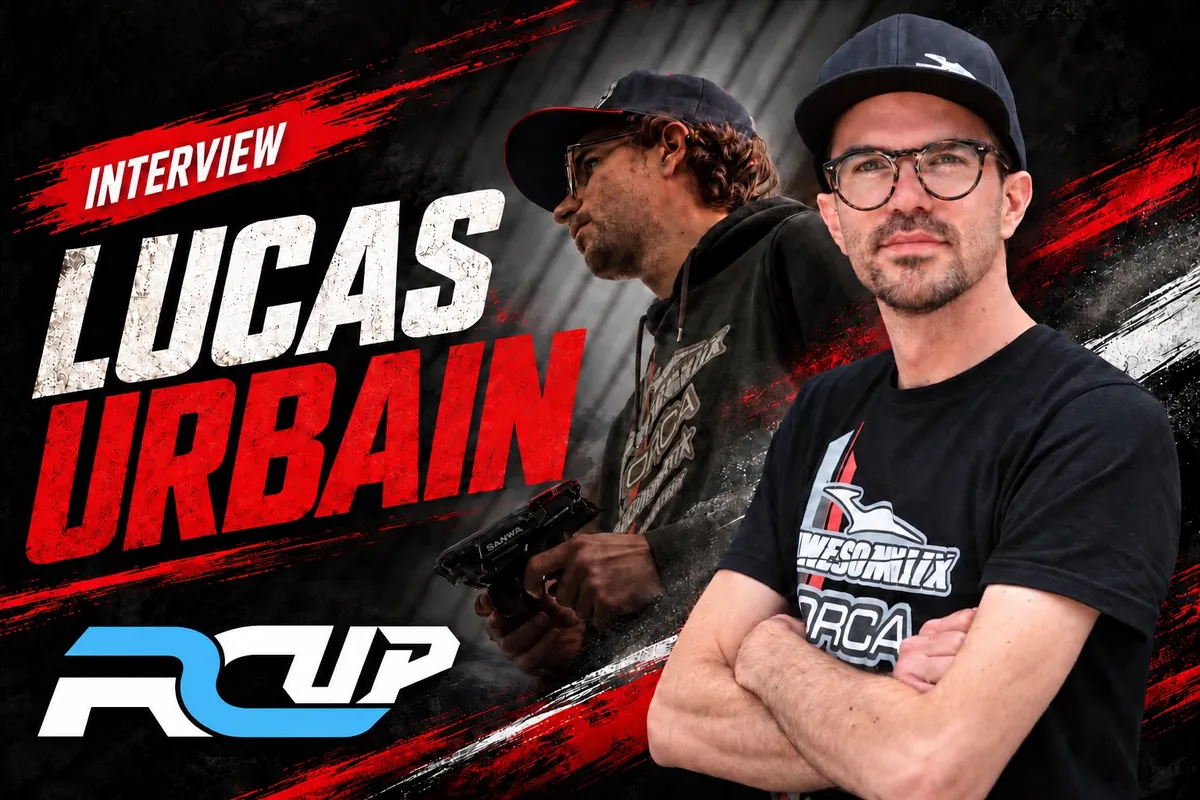
Lucas Urbain raced at the highest level while working on the French railways. Today RC is his living, with Awesomatix, alongside Oleg and Max.
We talked about talent and obsession, about Marc Rheinard moving to XRAY, about Italy, about touring cars that have become too specialised, and about the one thing he would change in world RC.
What came out is an interview about what never shows up in the standings — and about what, if you keep believing, eventually pays off.
Nothing is for free
Lucas, your journey is quite different from that of many professional drivers. For years you worked on the French railways while competing at the highest level of RC racing. Now that RC has become your full-time job, do you think those years of balancing work and racing made you a stronger driver?
Making it full-time had always been somewhere in the back of my mind as I kept climbing the ladder into the hobby. But if I look at where I was, say, ten years ago, I simply wasn’t good enough to seriously consider making a career out of it. My results weren’t really there, and even though I could occasionally show up at the very front I was simply not consistent enough.
Balancing work and racing was simply part of the game, as it is for the vast majority of drivers, even though it meant missing out on a few major events at times. If anything, that taught me that nothing is for free, and I viewed racing as a reward.
Back then my life already kind of revolved around RC anyway. All my holidays were spent racing, and nearly every single day off was spent either wrenching, practising or racing.
I will be forever grateful to Oleg and Max for giving me the chance to make a living out of it, while also appreciating the fact it happened rather late in my career — making me cherish each step of the process even more.
RCup.it: Full-time came late, and that is exactly why each step weighs more. For years the race was not the job. It was the reward.
Talent was never a shortcut
You didn’t become one of the fastest drivers in the world overnight. Your progression has been very steady over the years. How much of speed is natural talent, and how much can actually be built through hard work, experience and attention to detail?
It was obvious from day one that I had a little something extra compared to the other kids when I entered my first ever club race. However, there was barely any structure, nor a racetrack, where I started. Just a parking-lot track and manual lap counting, and nobody around us with any advanced experience to show us what RC racing could really be. So there was no fast track, no shortcut.
Soon enough we formed a small group to go racing outside our club, and we sort of became a driving force inside the club to gradually improve our structure and our skills.
At that stage I believe it became ingrained in my way of doing things: just figure it out on my own. Even today, that’s the only way I know how to improve. Perhaps it takes me more time, but it also means each step of my progress has been built on more solid ground.
However, I would also not necessarily take myself as a good example of how to succeed. It took an obsessive, sometimes unhealthy amount of commitment to keep doing it over and over again even when I could not directly see progress. It was just a belief that eventually it would pay off, almost to a fault.
RCup.it: There was a little something extra at the first club race. There was no shortcut. Urbain does not offer himself as a model. He offers himself as someone who kept going when the progress was invisible.
Marc, now on the other side
For many years you shared the Awesomatix team with Marc Rheinard, developing the same car while also fighting each other on track. Now that Marc has moved to XRAY, does racing against him feel different? Is there perhaps even a little more motivation when you see an XRAY with Marc behind the wheel?
It doesn’t change much. At the end of the day we’re still racing and we want to beat each other, as well as everyone else. If anything, there is now a bit more freedom to fight on track, wheel to wheel, if we’re ever fighting for position.
RCup.it: Rheinard in an XRAY does not change the will to beat him. It changes the space: on track, wheel to wheel, there is more freedom.
It always comes down to driving
At the highest level, almost everyone is incredibly fast. How much can a driver still make the difference today, and how much comes down to finding that tiny advantage in setup, tyres and preparation?
I believe it always comes down to driving. Car setup is just a tool to get into your comfort zone, but at the end of the day the driver makes the difference. It is clearly no accident that we keep seeing the same names at the front.
Sure, you can find a few missing tenths purely with car setup, and when the racing is that close it can make all the difference. But it is only a few percent here and there. Still, the bulk of the work is driving, and that’s where the best drivers shine: they can compensate for an imperfect car, no matter the conditions.
RCup.it: Setup steals a few tenths. Over time, the standings belong to the driver who can still go fast in a car that is not perfect.
Don’t predict the car
After so many years with Awesomatix, you probably understand the car better than almost anyone. Can it still surprise you when you test something new, or can you almost predict how the car will react before you even put it on track?
Car development and setup is a funny business. Every time you think you have something figured out, reality finds a way to kick you and force a second look at what you thought was true. You can’t ever take anything for granted, because there are so many moving parts, both literally and figuratively. Car design and setup is a problem with multiple solutions.
I keep getting surprised when I try a teammate’s setup: how wide the setup envelope can be, and how different two perfectly valid setups can look. Not to mention how “out there” some of Oleg’s suggestions and ideas can be sometimes.
Still, with that in mind, we are fully aware of the strengths and weaknesses of our platform, and it doesn’t take me many laps around a new track to get a good grasp of where we are going to be strong and where we are going to struggle.
However, I no longer like to make predictions. Keeping an open mind and avoiding preconceived ideas is, in my opinion, the best way forward. Experience should help you understand what you’re seeing, not make you believe what you expect to see.
RCup.it: Two valid setups can look like two different cars. For Urbain, experience is for reading the track — not for confirming the idea you brought from home.
The last lap, I’d pick Marc
You have raced against most of the best drivers of your generation. If you had to choose just one opponent to fight for a World Championship on the final lap, who would you choose — and why?
I’d choose the young beginner from the club next door if that ensures an easy win 😉.
Jokes aside, I’d probably choose Marc. He’s next-level good when it comes to a world championship final, which he has proven countless times. So for the impossible challenge that would be, I’d fight Marc.
RCup.it: The joke about the beginner lasts a second. Then there is only one name: Marc, because a world final against him is the impossible challenge.
Motorsport in the DNA
You have raced in Italy several times and know our RC scene quite well. From the outside, what do you think Italian RC racing does particularly well, and what do you think we still need to improve?
I keep getting blown away by the general level of RC in Italy. It really feels like you have motorsport in your DNA. Wherever I go, I meet really dedicated and talented drivers whom I bet could have their chance if they travelled more. I feel like some of them don’t realise how much they would likely shine in different circumstances, in a part of the world where the touring-car scene is more active.
Similar to France, Italy has a real RC legacy that goes back into the previous century, with plenty of clubs and tracks scattered around the country. So far I must say I have really liked the attitude of the clubs I have visited towards track conditions. Back home, we tend to have more of an “it is what it is” attitude towards grip. In Italy, that doesn’t seem to be good enough. If racers want more grip, clubs find ways to make it happen, making practising and racing far more enjoyable.
RCup.it: In Italy, grip is not “it is what it is”. If the drivers want it, the clubs go and find it. For Urbain that, more than a title, is the sign of a scene that looks after the racing.
Cars that only work in one window
1/10 touring has become incredibly sophisticated and the performance level is impressive. Do you think this constant technical evolution is healthy for the category, or are we reaching a point where touring is becoming too expensive and complicated for newcomers?
I do believe the evolution of touring-car platforms has led towards overspecialised cars that tend to perform only in very specific conditions. They require a lot of knowledge to be enjoyed, and even though that knowledge is more widely available than ever, I believe simpler entry-level chassis classes could really be needed as a stepping stone into the hobby.
It has become increasingly difficult to recommend some of the latest touring chassis to a newcomer, because the likelihood of them having a good experience is perhaps at an all-time low, increasing the chance of them dropping the hobby altogether. The average hobby driver’s level is higher than ever, and for a newcomer to bridge that gap is becoming increasingly difficult.
I would rather see simple, reliable plastic entry-level chassis make a resurgence, with a dedicated class at all levels of competition. That would give newcomers a clear path into the hobby and allow them to take part at the highest levels without investing so much time and money, while still keeping them where the racing is happening — and hopefully improving how many of them stay.
RCup.it: The latest chassis is not an invitation. Without a simple step, the newcomer hits a wall — and leaves.
Sometimes you have to lift
There is a big difference between racing because you love it and racing because it is also your profession. Now that RC is your full-time job, do you still feel the same excitement when you arrive at a track, or has the pressure to perform inevitably changed that feeling?
Being at the track is still what I love the most. I feel at home there, and I can just be myself. It is true that my schedule is more packed than ever, with rare and short breaks.
Something new, that I am still learning to deal with, is attending races I am not overly keen on attending. I no longer have the excuse of being needed at work, and I caught myself once or twice thinking, “let’s get it over with”, which is entirely new — while still having to dig deep to deliver the best possible result.
The funny thing is that being always fully committed is not always the best way to perform. Sometimes chilling a little and simply enjoying myself is exactly what puts me in the right mood to drive at my best. That’s something I must remind myself of now, because while being on the job, taking my foot off the gas can easily feel like I am not being professional, even when it might actually be the best thing for my performance. Finding the right balance there is still something I am working on.
That said, the anticipation of climbing onto the rostrum and having to drive as fast as I can will never change. That is still the part that gets me excited every time.
RCup.it: Being always “on” is not always being fast. Lifting, sometimes, is the most professional thing he still has to learn.
Racers are not an audience
Tomorrow you are given complete control of RC racing worldwide and you can change just one thing — rules, costs, race formats, promotion, categories, anything you want. What is the first thing Lucas Urbain would change, and why?
I would love to have the major governing bodies, national and international, change their mentalities. Treating racers as customers, races as products and racing as an experience is what privately organised series understood a long time ago, and what legacy governing bodies have failed to comprehend. They often have it backwards and just provide boundaries on how the hobby should be run. I often get the impression that I should just be thankful they offer such prestigious titles thanks to their heritage, and that in itself is good enough.
I am worried that if they don’t change their ways, they will eventually lose out to privately owned race series for good. In my opinion that will only lead to loads of unforeseen consequences that will benefit nobody.
RCup.it: Prestigious titles are not enough if the organiser treats the driver as a guest. Private series understood that. The big bodies, for Urbain, have not — and in the end the scene pays the bill.
RCup.it
Maybe the truest line in the whole interview is also the least comfortable:
experience should help you understand what you’re seeing, not make you believe what you expect to see.
Because behind Awesomatix, the full-time job and the names that keep showing up at the front, something talent alone cannot explain remains: years in which nothing was for free, and the race was the reward.
Fewer shortcuts. More craft.